Monday, February 18, 2008

My Father! The Father and Son

As proud as Solhi was proud of us, nothing compared to how proud he was of his own father.

Hamed, and in the middle with Solhi, Cynthia, Widad, and me hiding behind Hamed

Solhi was very proud of his father, and he revered him. Hamed travelled a lot, all over the world, but whenever he came to visit us in Syria it was always a ritual. Most often it would be by car coming from Beirut, and Solhi would be at the border, with us in tow, meeting him.


Hamed in Lebanon

Hamed in the early 50's developing the farmlands


Hamed was a devout religious person, a trait that Solhi and Hamed didn’t share, but in deference to Hamed’s feelings, whenever he got word that Hamed was coming, Solhi would make me memorise a verse from the Koran. And when Hamed arrived at our house, before he would sit down, Solhi would ask me to recite the verse I’d memorised in front of Hamed. Those moments were special to Hamed.

Hamed on the farmlands

Hamed had a special place in his heart for me, and like Solhi, I called him Baba. I always looked forward to his visits, mostly for selfish reasons, for whenever he visited I always ended up with 100 Iraqi Dinars in my pocket when he left, that was a lot of money in those days. But Solhi, always thrifty, and always conscious to teach us the value of money, would take it from me and put it in his ancient safe for me.

Hamed in Alexandria dropping Solhi off at VC


Hamed died in Baghdad on 8th August 1966. Solhi was 32 years old, I was 10. Solhi was again to be devastated. He was in Damascus at the time. There was no fuss, no sign that there was anything wrong. All I remember was walking into the living room and seeing Solhi sitting in his chair staring blankly into space. When he saw me walking into the room he looked at me and told me that Baba had died, and then broke down crying. All I could do was go to him and hug him. I remember him holding on to me for what seemed like an eternity. That hug will remain in my memory forever.


Solhi at around the age Hamed died


To my childlike eyes, Solhi’s relationship with his father was a complex one. I later learned that Hamed did not initially approve of Solhi marrying Cynthia, he did not see that there was a future in a multicultural relationship. Solhi’s uncle Shaker, who was Iraqi Foreign Minister in the mid 1950’s, introduced a law forbidding Iraqis from marrying a foreigner, and that was a cause of a family dispute that lasted over a year.

Solhi with his uncle Shaker


Whether by design or by default Solhi still was a rebel. However, eventually both sides relented and reconciliation took place. Both Solhi and Cynthia proved that their relationship was solid and extremely strong, time was the ultimate proof. Their marriage lasted 52 years, until Solhi died.


Solhi and Cynthia at various stages in their lives

When Hamed died Solhi inherited a huge legacy. Hamed was the Chief of the Dulaim Tribe, one of the largest in Iraq, and when he died, this position was assumed to automatically pass on to Solhi. The Tribe’s elders approached Solhi to pay their respects and to hail him as their new Chief, but Solhi declined to accept this position. He didn’t feel that he was sufficiently suited to take on this responsibility, besides he had his own priorities. Music was more important than status to him.

Solhi, seated 2nd from left, sampling food the tribal way with body guards looking on


With Hamed’s death Solhi also found himself unexpectedly burdened with huge death duties that would take him 10 years to pay off. He also inherited large farmlands that he didn’t know what to do with. Over the years he had many offers to sell the lands but he always rejected them in respect of the memory of his father who worked hard to build and develop them. And Solhi was never materialistically minded, wealth meant nothing to him.


Solhi and his inheritance


He did however realize that he would have to travel more often to make sure that his father’s legacy was not abused, and not wanting to disturb my education he made a momentous decision to send me to boarding school. This proved to be a turning point in our family’s life.


Me at around the age that Hamed died


Having himself gone to boarding school at Victoria College he knew what effects boarding schools have on young children. I was 11 at the time, the same age he was when he was sent to VC. His dilemma at the time was where to place me. VC was out of the question since it was nationalised by Gamal Abdul Nasser following the Suez Crisis in 1956, and its status and standards had declined. The matter was settled by an old friend of his, Kamal Haffar, who boarded at Brummana High School in Lebanon, and whose sons Rifaat and Omar were boarding there at the time. And this is how it came that I was sent to BHS, considered then to be one of the best schools in the Middle East.


Brummana High School (Pictures courtesy of Francis Hudson Nehme)


So in October 1967 I was taken to Brummana and dropped off at BHS. My mother promised that she would come visit me the following weekend, and on that Saturday I waited, and waited, but she never showed up. I felt completely alone for the first time in my life. I would later learn that she, being British and requiring a visa, was unable to get one in time.

Me in Beirut at 11 being dropped off at BHS for the first time


In my early days at BHS Solhi would come to pick me up to take me home for the Christmas, Easter and Summer holidays, he would also take me back when the holidays ended. Early on I would look forward to the journey back to Damascus, but as time passed I became more excited about returning to BHS than leaving it. This must have been a cause of irritation to Solhi, but he never showed it.


Solhi in a moment of relaxation

One time on the way back to Brummana we arrived at the border and Solhi asked me for my passport. My heart sank as I suddenly realised that in my excitement I’d forgotten to pick my passport up. Solhi looked at me, with his famous frown, and after what seemed like an eternity he reached into his pocket and produced my passport. He didn’t need to say much after that. I learnt my lesson, and I’ve become meticulously careful ever since.

Solhi, Cynthia, Diala and Hamsa circa 1977

In those younger years I didn’t realise the sacrifice my parents were making by sending me away to school. I missed them badly but considered it a part of life. The signs were there though.


Solhi in Iraq


One day in heavy rain, I was still in primary school, a friend and I, (and to this day I remember who that friend was,) were kicking a football around in a sheltered area and I noticed a man out in the pouring rain, wearing a long raincoat, standing, soaking wet, and freezing cold, waving in our direction. For a long time I didn’t give him a second thought, but every time I looked in his direction he would wave. As I looked over to this man, once, and then twice, I started to think he looks very much like Solhi. I wasn’t expecting him. Eventually I walked over to have a closer look, and sure enough, it was him! Once I realised it was him I couldn’t get to him fast enough, I ran to him and jumped into his arms and hugged him as hard as I could. He had driven over 4 hours in horrendous weather just to see me for an hour, and then drove back home.


In Baghdad


Some 25 years later, during a visit to the UK, Solhi, out of the blue turned to me and asked me a question that he said he had always wanted to ask me: did he make a mistake by sending me to BHS? The question came as a surprise since I never, ever, imagined he had any self doubt about any decision he made. The relief on his face was palpable when I told him that my 8 years at BHS were the best years of my life.

Thursday, February 07, 2008

My Father! The Father


I was born at St. Mary Abbots Hospital in Kensington in London on 17th may 1956. Solhi and my mother Cynthia were still students at the Royal Academy of Music. I was 16 days late coming to life, and while Cynthia was giving birth to me at 8 am in the morning Solhi was on the Albert Bridge off the Chelsea Embankment staring at the Thames. Fathers were not allowed into the delivery room in those days, but even if they were, Solhi would probably still have been on that bridge, contemplating the Thames.


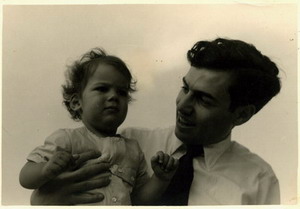
Solhi with me in London shortly after I was born

Solhi was 22 years old when I was born. In later years my mother would say that he was too young then to become a father, but he was much older than that age. By then he already had a vision and a future planned. He knew he had many obstacles to overcome, and he was ready for them. Now he had a massive incentive.


Damascus 1956

My coming would change his life. My coming into his life had a profound effect on him. From as far back as I can remember into my childhood I remember being flooded with love and affection. 6 months after I was born my father took me and my mother to Damascus. I was the first born to any of Hamed’s children, and that was a great source of pride to Solhi.


Damascus 1956


Baghdad 1957

On 4th of December 1957 my sister Hamsa was born in Baghdad, and I had a sibling. It was a happy time. This event added to Solhi’s joy, life couldn’t be better. A son and a daughter whom he hoped would have the same love for music that he did.


Left, Hamsa in Baghdad. Right, Hamsa and I in London

Over the next few years we travelled a lot; between London, Damascus and Baghdad. In those days travel was a long drawn out affair. Many times we travelled between Damascus and Baghdad by car, a 16 hour journey, much of it on dirt roads. Flights also lasted much longer than they do now, and Hamsa and I must have been a burden, but we remember little of it.


Left and middle, Cynthia and I in London and Solhi's philosophical script on the back of the picture on the left. Right, crossing a stream in Syria

From as early I can remember Solhi insisted that I call him Solhi. He wanted me to be as one with him. Hamsa and Diala, who was born on 20th July 1962, followed on from that lead. Hierarchy and tradition had no place in his life.


Left, Hamsa and I in London. Middle, Hamsa and I in Damascus, Hamsa had Mumps and Mum wanted me to be infected at the same time, feeding us from the same spoon, but I never did get infected. Right, Hamsa and I in the countryside in Syria

Left, Hamsa kissing Diala. Right, Hamsa, Diala and I.

From a very early age he started indoctrinating us to enjoy music. I was about 5 years old when I had my first lesson playing the violin. It didn’t take long for Solhi to accept that the violin was not the instrument for me, so my mother took over the mantle and I started piano lessons. My mother was always much more patient, and so the efforts to get me to show some form of stubbornly latent talent took longer, but the end result was the same. It must have come as disappointment to Solhi that I didn’t show any signs of child prodigality but he never showed it. In the meantime Hamsa, in stark contradiction to me, showed early signs of brilliant talent.


Hamsa on the violin and piano.

Like me, Hamsa did not escape the trials to find musical talent. She went through the violin trial period with no success, but when she was put in front of a piano, a miracle happened. She took to the piano like a duck takes to water. And to Solhi’s delight, a child of his showed serious musical talent.

Hamsa grew to become an accomplished concert pianist and teacher

Solhi was an exceptionally serious person. He admired Beethoven and Wagner, and marvelled at their moody genius. He deliberated over the talents of Mozart and Schubert and wondered at their potential output if they’d survived beyond their early 30’s. He studied with fascination the bold music of Mahler and Shostakovich. He drew much of his inspiration from their lives.

Solhi in contemplative mood in Syria on the left and in Iraq on the right.

But Solhi was not exclusively dedicated to music, and our childhood was not all about music. One of his fascinating qualities was that as serious as he was he was also frivolously mischievous. He was an accomplished practical joker; exceptionally witty, and uniquely funny.

Solhi in some of his frivolous moments

Solhi loved nature, and never wasted an opportunity to take us out of the city into the countryside, whether it was for picnics, or to visit Roman amphitheatre at Busra and the ruins at Palmyra, or to swim in the sea, or to wade in rivers.


In Syria, in a river top left, Zabadani top middle, Busra top right, near Tartous bottom left, Ghouta bottom middle, and Busra bottom right

Palmyra with the Abouds. Nadra, Solhi and Cynthia with Diala on the left. Hamsa, Hind, myself, Ibrahim and Diala in the front.

Palmyra again, Solhi on the left, Cynthia in the middle, and Solhi with Abdul Kader Arnaut on the right.

Solhi with Hamsa on the left on the farm in Baghdad

Solhi in Syria. Sameem Al Sharif can be seen in the picture on the left.

Solhi also loved animals. From as early as I remember into our childhood we were surrounded by cats, dogs, birds, fish. Solhi could not walk past a wounded or hungry animal without picking it up and bringing it home. Some of those animals are still alive today! Solhi loved Salukis. He considered them regal dogs. But Solhi’s pride and joy was a Russian Borzoi named Boris.


Solhi with Boris the Russian Borzoi

When I grew older he would take me on hunting trips with his friends. Those were magical times. Waking up well before dawn and travelling long distances, and then walking miles on hunting trips were always occasions I relished. They were adventures every young man dreams of, you could never predict what would happen. I remember one time, in miserable weather conditions, we strayed by mistake into Lebanon and ended up in a village somewhere near Mount Hermon. The only way we could tell we were in Lebanon was when we saw shops selling Coca Cola and good quality shotgun cartridges. These things were not available in Syria then. We didn’t pass any border point, and we didn’t even have our passports with us. We must have followed a smuggling route and inadvertently ended up in Lebanon. We returned the same way, and I had an amazing story to tell my friends. In those days going to Lebanon was an exotic occasion, and doing it without passports and without being detected made it even more exotic. In later years I would end up going to high school there, legitimately. And many years later I would even settle there, also legitimately.


Solhi with various hunting partners and friends, among them Salim Aboud and Michel Kilo, and myself

Solhi was a stern father. Partly due to his own spoiled childhood, and partly due to his strong personality, he raised us with an iron fist, literally. None of us escaped his famous “knuckle knock” when we’d done something he did not approve of. That would be a hard knock on the forehead with the 2nd joint of his third finger. Painful and effective. Just as painful and probably more effective was the just-as-famous raised-eyebrow frown.


Receiving a dressing down in Busra

But Solhi was also very proud of us, and always strove to pass on his knowledge to us. On many occasions he would sit Hamsa and me down and, with volume blaring, play records of famous compositions, and tell us the stories behind the compositions and the composers. He would bring out the score sheets and teach us to follow the score. Then there would be the spot checks: “What instrument is this?”, “What key is this?”, “What speed is this?” and so on. This type of quizzing was not limited to music, he instilled in us many of life’s values this way.

Tuesday, November 27, 2007

My father!

This is the first of a series of posts I will be posting over the next few weeks as a tribute to my father:


My father died on 30th September 2007. He eventually succumbed to the brain haemorrhage that felled him on the podium while conducting the Syrian National Symphony Orchestra on 27th April 2002.

That stroke should have killed him then and there, but such as he was, he defied all odds and lived 5 years, 5 months and 3 days longer than he should have. To Syria he was a “National Treasure”, but to me he was my father, and my friend.

Solhi Al-Wadi was born in Baghdad on 12th February 1934 into Iraqi aristocracy. His father, Hamed Al-Wadi, was the leader of the Dulaim Tribe, and was Chamberlain to the Royal Court (Al Diwan Al Malaki) of King Abdullah I, then King of Transjordan. His uncle Shaker Al-Wadi held positions of Minister of Defence of Iraq and Minister of Foreign Affairs at various times. At the time Solhi was born Shaker was Iraqi Ambassador to Iran. Solhi was the only boy in the Al-Wadi family and was spoiled rotten. His uncle Shaker took him everywhere he travelled. The picture below was taken in Tehran.


1st Picture: Solhi with Shaker.
2nd picture: from L to R: Hamed, Sarmad, Solhi, Cynthia, and Widad (Hamed's 2nd wife)


Hamed Al-Wadi came to prominence during the Arab uprising against the Ottoman Empire during World War I. He fought the Turks alongside King Faisal I and Al Sharif Shaker Bin Zeid at the time when T.E. Lawrence (Lawrence of Arabia) had promised the Arabs self rule. They were later betrayed by the Sykes-Picot agreement which divided up the Middle East as mandates between the British and the French.


The Three Kings - Seated from L to R: King Ali, King Abdullah I, King Faisal I. Behind King Abdullah in black suit, Hamed.


Al Sharif Shaker Bin Zeid on the extreme left, Hamed on the extreme right. In the middle in the black suit Hamed's brother Shaker Al-Wadi


Hamed's children grew up with Al Sharif Shaker’s children. Solhi and Shaker’s son Prince Zeid Bin Shaker, who was born in the same year as Solhi, grew up as brothers. They were inseparable. They went to school together, then to London together where Zeid Bin Shaker went to the Royal Military Academy at Sandhurst. Zeid and Solhi remained best friends until Zeid’s sudden death in September 2002. By then Solhi was incapacitated, and he was never told of Zeid’s demise.


Solhi with his childhood and school friends: Zeid Bin Shaker in military uniform in the 1st picture. Ghazi Shaker in all 3 pictures.


Hamed was away from home for much of the time, and Haddia, Solhi’s mother, for various reasons, preferred to live in Damascus rather than Baghdad, so soon after Solhi was born, the family relocated to Damascus.


Solhi with his mother Haddia Burjaq Al-Wadi

Solhi was a rebellious child. He was the only boy amongst 3 sisters, and his mother doted on him. In an effort to get him under control he was sent to boarding school at Beirut College for Women which took boys Solhi's age, but he promptly ran away to the Iraqi Embassy and demanded transport back home, which he got. Solhi was then enrolled at the prestigious Victoria College in Alexandria in Egypt which was further away. He was dropped off there by his parents where he protested further by purloining his parents’ passports and hiding them in the lavatory cistern in his hotel room. It took them a long time to get him to confess. He was only 11!


Solhi at 11 in Alexandria when first dropped off at VC

At VC he joined his best friend Zeid and was class mates with the likes of King Hussein of Jordan, Sultan Qaboos of Oman, Hisham Nazer, Adnan Khashouggi, Ghazi Shaker and many of the Arab aristocracy of that generation. Despite that, he remained a rebel; smacking the future king of Jordan in the face when he inadvertently broke one of his precious old 78 rpm speed classical recordings, and repeatedly attempting to run away from the regimental system that was in place by the British administration at VC. One time he made his own way to Cairo on a train trying to con his way back home.


1st picture - L to R: Ghazi Shaker. Solhi, Zeid Bin Shaker. 2nd picture: Solhi with Hisham Nazer. 3rd picture: Solhi and Zeid with others.

During his time at VC he developed his love for music, and to silence those detractors who considered him less than manly because of his love for music he played his way to become captain of the VC senior football team. By all accounts he had a lethal left foot!

Solhi with the various trophies won in football. In the 1st and 3rd picture Solhi is to the left of the man in the suit. In the middle picture Solhi is between the 2 men in suits.


In the summers Solhi used to return to Damascus and he soon mixed with the fledgling classical music enthusiasts and other members of a revolutionary movement with a love for the fine arts, people like Sadek Faroun and Rafah Qasawat. Sameem Al-Sharif, who was a childhood friend of Solhi’s, and who later married his sister Huda, was instrumental in getting this group together. Sadek and Rafah played the violin while Solhi played the viola and conducted. They persevered and eventually, with 3 instruments, played the Introduction to Boildieu’s “Calif of Bagdad” and the 2nd movement of Schubert’s Unfinished Symphony at the Ommayad Hotel in front of an astonished public. In the late 1940’s this quartet started the serious classical music movement in Syria.


Clockwise: Irfan Hadaya, Mohamed Al-Amir, Sameem Al-Sharif, Solhi, Albert Fitz

Solhi’s mother died in 1953 when he was just 19 years old, and he was devastated. He absolutely idolized his mother, and often during his illness he would call out for her.


Solhi and his mother in a frame made specially to commemorate Solhi's birth

Shortly after that his father sent him to London. Solhi was sent to London to study agriculture with the view that he would eventually return to Iraq to manage the farmlands his father had developed and nurtured. But Solhi had other ideas and greater ambitions. Unbeknown to his father Solhi enrolled to study at the Royal Academy of Music. He had a love for conducting; he also loved the sound of the viola. So he studied both as well as composition. And when his father found out that he is not studying agriculture and threatened to stop his allowance, he started studying agriculture as well.

It was during this time that Solhi met my mother Cynthia, a Welsh born young lady from English parentage, who had earned a scholarship to study the piano at the Royal Academy of Music.

She would observe this handsome foreigner in a long coat and a hat with a viola under his arm walking into the Academy and wonder about him. Eventually she would join him in the cafeteria where he would sit with friends and talk enthusiastically about music and composers they’d never heard of before; Prokofiev, Shostokovich, Mahler, Bruckner, Nielson, Sibelius and others.


Solhi and Cynthia in London in the mid 50's


In 1960 Solhi returned to Damascus and started work on establishing classical music as part of the music and fine arts scene in Syria. In 1962 he founded the Music Conservatory in Damascus, which later became the Arab Institute of Music, and he was appointed its Dean.


Some of the early students at the Conservatory


Solhi struggled hard in the early years of the formation and evolution of the Music Conservatory. He constantly came up against doubters, traditionalists and suspicious individuals who did not believe there was a place for classical music in Syria. However, a new class of classical music enthusiasts was simultaneously being born, and with it a new generation of performers and artists.


Students undertaking their exams

Solhi observing the exams

Solhi brought into the Conservatory foreign specialists; piano teachers, violin teachers, cello teachers, music theory teachers, etc. mostly from the former Soviet Union. By the late 1960’s many of the Conservatory students were being dispatched to the Soviet Union, to further their studies, on government sponsored grants. He hoped that these students would return and take up teaching positions at the Conservatory while its student base grew and the Conservatory grew with it. Solhi would be repeatedly driven to despair when many of the students returned from abroad and joined local popular Arabic music bands, mostly because they were paid more money.


Students and teachers

Solhi fought hard for his students and always stood up for them. He was also very firm with them. He stood no nonsense and would not tolerate behaviour less than that befitting their status as talented serious musicians. He was very quick to recognize a musical talent in students and was passionate in encouraging and nurturing it, yet he would have no qualms in punishing any student if he felt that they were wasting their talent. His uncompromising attitude soon earned his students’ respect, and this most often led to unbreakable friendship.


Solhi with some of his students

Solhi had a revolutionary approach with his students. He treated them as friends and they would often come over to our house where we would sit together and listen to music and discuss in great detail various composers and compositions. We often went on trips to the country together.


Solhi with more of his students

Over the years enough students achieved sufficient competency levels for Solhi to start thinking about forming a symphony orchestra. After many years in the planning the Syrian National Symphony Orchestra was founded by Solhi in 1993, and he was its resident and principle conductor. This orchestra started performing in Syria, and soon started receiving invitations to perform in countries abroad. Over the next few years it would perform in Lebanon, Egypt, Kuwait, Iraq, Jordan, Tunisia, Turkey, Spain, Germany the United Kingdom and the United States of America. Solhi also received invitations to conduct other national orchestras in various countries.

An orchestra evolving

His work was also being recognized at the highest level of Syrian government officialdom. The late President Hafez Al-Assad supported the development of the Music Conservatory from its early inception, and personally followed its progress.


Students and teachers with President Hafez Al Assad


In 1995 President Assad honoured Solhi with Syria’s highest civilian award, the Order of Merit in its highest classification.


Dr. Najah Al-Attar, Vice President of the Syrian Arab Republic, then Minister of Culture, after bestowing the Order of Merit Medal upon Solhi


In the years to come demand for higher education in music grew and the High Institute of Music and Drama was established in a modern new complex. Solhi was appointed its Dean. This complex also included the new state-of-the-art Dar Al Assad Opera House. Solhi supervised its construction and looked forward to performing the Opera Dido and Aeneas by Henry Purcell at its opening, however, his illness prevented him from doing so.

The High Institute of Music and Drama


Solhi's office


The entrance to Dar Al Assad (Opera House)


In 1999 the Komitas State Conservatory of Yerevan in Armenia awarded Solhi an Honorary Doctorate, and in 2000 the Russian Academy of Arts and Sciences granted him an Honorary Doctorate.


Solhi receiving an Honarary Doctorate from the Russian Embassador

Solhi organized many of his concerts in churches around the world, and in particular in Damascus. He had a particular love for chorale music, and requiems. This led to him being recognized and honoured by leaders of the various churches in Syria.

Metrapolitan Georgous Archbishop of Homs presenting Solhi with a shield

Solhi conducting a Chorale in the presence of Isodore Battikha Archbishop of Damascus

In May 2001 Pope John Paul II visited Syria as part of his Millennium tour, and on 5th May Solhi conducted the Syrian National Symphony Orchestra in the Mass at the Abassid Stadium in Damascus where it was attended by thousands of worshipers. I was fortunate enough to be present for that occasion. In recognition of his services to music in Syria Pope John Paul II honoured Solhi with the Medal of St. Peter and St. Paul during this visit.


Papal Mass in Damascus, May 5th, 2001


The medal of St. Peter and St. Paul

The last of Solhi's concerts that I attended was in April 2001 in Beirut where Solhi conducted the Lebanese National Symphony Orchestra at St. Joseph's Church in Monot. Also present at this concert was Prof. Ahmed El-Saedi, then Director and principle conductor of the Cairo Symphony Orchestra. Solhi, Dr Gholmieh and Prof. El-Saedi were in the process of planning a joint venture with the three orchestras, however, Solhi's illness put an end to this project.


Solhi and Walid Gholmieh
Solhi conducting the Lebanese National Symphony Orchestra

Friday, July 27, 2007

The Prickly Pear Cactus Fruit

Fulfilling my promise to Debi, Rima, Frances and others to post some pictures of the Prickly Pear Cactus fruit. In the Middle East this is a delicacy, normally found being sold on streets by vendors. They ripen and are commonly sold on the streets around July/August. Street vendors have them displayed on la